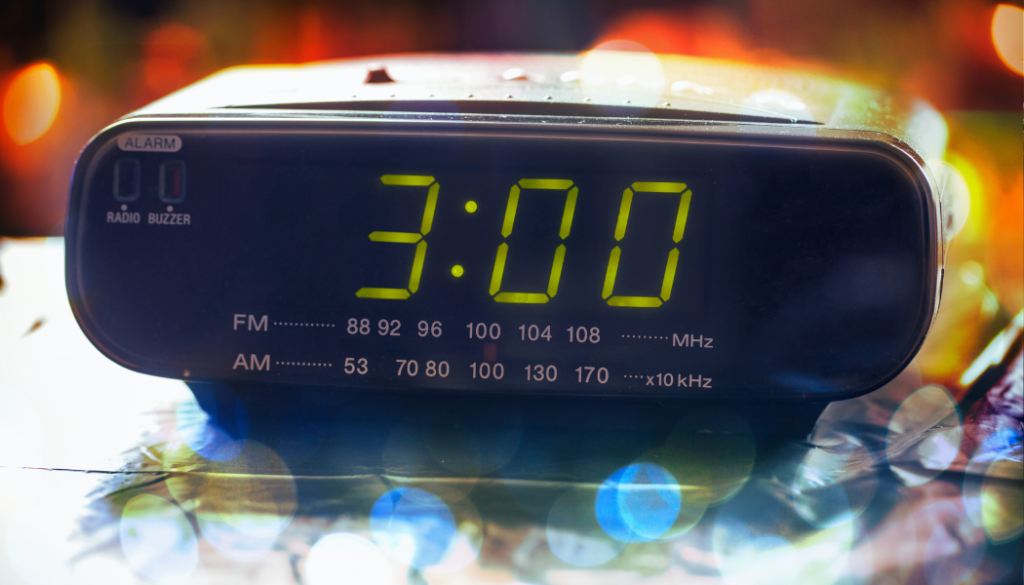
It’s 3 AM and you’re awake again.
Not because you want to be. Not because you’re rested and ready to start the day. Because your brain decided this was the perfect time to replay every mistake you’ve ever made, every worry you’ve been suppressing, every possible disaster that hasn’t happened yet.
You stare at the ceiling. Your heart beats a little too fast. Your mind offers up a highlight reel of everything wrong with your life, your choices, your future.
And the worst part? You know it’s irrational. You know tomorrow morning you’ll look back and wonder why you were spiraling over something so small. But right now, at 3 AM, it feels huge. It feels true. It feels like this is the real you and the daytime you is the fake one.
I’ve been there. More nights than I can count.
And here’s what I’ve learned: You can’t argue with a 3 AM brain. But you can learn to hold it differently.
Why 3 AM Is the Worst Time for Anxiety
There’s a reason the dark hours hit differently.
Your defenses are down. The distractions are gone. No work, no phone calls, no to-do lists to keep the worries at bay. You’re just… there. Alone with your mind.
Your body is tired but your brain won’t shut up. Cortisol (the stress hormone) naturally rises in the early morning hours as part of your sleep cycle. For people prone to anxiety, that spike can feel like a tsunami.
And in the dark, everything looks bigger. The thing that felt manageable at noon feels catastrophic at 3 AM. The comment someone made yesterday becomes proof that everyone secretly hates you. The financial worry becomes evidence that you’ll end up destitute. The health concern becomes a terminal diagnosis.
It’s not you being dramatic. It’s your brain, exhausted and unguarded, running worst-case scenarios because that’s what anxious brains do when they’re not supervised.
The first thing to know: This is not a moral failing. This is not you being weak. This is biology having its way with you.
A Night I’ll Never Forget
A few years ago, I had a spiral so bad I genuinely thought something was wrong with me.
Not metaphorically. I thought I was broken. Irreparably. Like everyone else got a manual for how to be a person and mine got lost in the mail.
It started over something stupid—an email I’d sent that day that could maybe, possibly, be interpreted the wrong way. By 2 AM, that email had cost me my job, my reputation, and all my friendships. By 3 AM, I was planning how I’d survive alone in a cabin in the woods with no human contact ever again.
I know how that sounds. It sounds ridiculous. It was ridiculous. But in the moment, it felt absolutely real.
I finally got up. Paced my apartment. Drank water. Cried a little. Sat on the bathroom floor with my back against the tub.
And somewhere around 4 AM, I remembered something my therapist once said:
“Your thoughts are not facts. They’re just thoughts. And thoughts can lie.”
I whispered it to myself. Over and over. “Thoughts can lie. Thoughts can lie. Thoughts can lie.”
It didn’t fix everything. But it created a tiny crack. A sliver of light. A reminder that the voice in my head wasn’t the voice of truth—it was just the voice of fear.
I made it to morning. The email was fine. Nobody hated me. The cabin in the woods stayed imaginary.
And I learned something: You don’t have to believe everything you think at 3 AM.
What Actually Helps in the Moment
When you’re in it—right now, tonight, in the spiral—here are things that can help:
Get up.
Don’t lie there trying to think your way out of thinking. It won’t work. Get up. Move to another room. Sit somewhere else. The physical shift signals your brain that something has changed.
Change the temperature.
Splash cold water on your face. Hold an ice cube. Step outside for thirty seconds if you can. Temperature change activates your parasympathetic nervous system and can literally interrupt the spiral.
Breathe like you mean it.
Not complicated breathwork—just slow. In for four. Hold for four. Out for four. Do it ten times. Your body can’t stay in full panic mode when you’re breathing like that. It’s physiologically difficult.
Name what’s happening.
Say it out loud: “I’m having anxious thoughts.” “I’m spiraling right now.” “This is my anxiety talking, not the truth.” Naming it separates you from it. You’re not the spiral—you’re the one noticing the spiral.
Fact-check yourself.
Ask: “What do I actually know to be true right now? Not what I fear—what I know.” The email exists. The rest? That’s story. That’s speculation. That’s fear wearing a disguise.
Get curious instead of consumed.
Instead of “oh no this is terrible,” try “interesting, my brain is really going for it tonight.” Curiosity creates distance. Distance reduces intensity.
Remember the morning.
You’ve survived every 3 AM so far. Every single one. This one won’t be different. The sun will come up. The thoughts will soften. You’ll be okay. Not because the worries weren’t real—because you’re still here, still breathing, still capable of making it through.
What Helps During the Day (So Nights Get Easier)
What you do in daylight matters at 3 AM. A few practices that help:
Schedule worry time.
This sounds ridiculous but it works. Give yourself 15 minutes a day to worry on purpose. Write down everything that’s bothering you. When worries show up outside that time, tell them: “I’ll see you at 3 PM.” Over time, your brain learns that worries have a place and don’t need to hijack your nights.
Move your body.
Anxiety lives in the body as much as the mind. Walking, stretching, dancing—anything that reminds your nervous system you’re safe and capable.
Limit what you consume before bed.
News. Social media. Intense conversations. All of it feeds the 3 AM monster. Give yourself an hour of softness before sleep. Read something gentle. Listen to calm music. Let your brain know it’s safe to rest.
Write it down before bed.
If your mind is racing as you try to sleep, keep a notebook by your bed. Dump everything out. The worries, the to-dos, the random thoughts. Tell yourself: “I don’t need to hold this—it’s on paper now. I can pick it up tomorrow if I need to.”
Be kind to yourself about it.
The worst part of 3 AM spirals is often the second spiral—the one about spiraling. “Why can’t I just sleep like a normal person?” “What’s wrong with me?” “I’m so broken.”
Stop. You’re not broken. You’re human. And humans have anxious nights. It’s not a character flaw. It’s just a hard moment.
A Practice for Tonight
If you wake up spiraling, try this:
Put your hand on your heart. Feel the warmth of your own palm. Take three slow breaths.
Then whisper (or think):
“This is hard. And I’ve survived every hard thing so far. I’ll survive this too.”
Not because the thoughts aren’t scary. Because you’re bigger than them. Because you’ve made it through every 3 AM that’s ever come for you. Because the sun always rises and you always rise with it.
You will again.
What I Want You to Know
The 3 AM thoughts are not the truth. They’re just the loudest thing in the room.
They feel real because it’s dark and you’re tired and your defenses are down. But they’re not facts. They’re fears. And fears, unlike facts, can be questioned. Can be held. Can be gently set down.
You are not your anxious thoughts. You’re the one noticing them. The one breathing through them. The one who will wake up tomorrow and realize, again, that the night lied.
The night always lies.
Morning tells the truth.
And morning always comes.
P.S. What’s one thing that’s helped you during a 3 AM spiral? Not to fix—just to share. I’d genuinely love to know. Drop it in the comments or hold it for yourself. Either way, it matters.