So, you’ve had your first few tarot readings. Some were scarily accurate. Others… you’re left staring at the cards thinking, “This makes no sense.”
You shuffle, fan out the cards, and maybe you pull The Tower, The Devil, and The Ten of Swords. The classic “scary card trio.” Or you get a card that seems to have nothing to do with the question. Panic? No. This is the moment.
In tarot, a “bad” reading or a confusing spread isn’t a failure. It’s often the deck—and your own intuition—asking you to look a little closer. The cards that “don’t make sense” are often the ones that matter most.
When the Cards Seem to Miss the Mark
First, a truth: the cards don’t lie, but they don’t read your diary either. Sometimes, the confusion is a you problem, not a card problem.
1. The “This Makes No Sense!” Problem You asked about your love life and got the Knight of Pentacles. Where’s the Knight of Cups? The romance card? The problem might not be the cards, but your question.
- The Fix: Get Specific. Instead of “What’s going on with my love life?” try “What is blocking me from the relationship I want?” or “What energy should I bring to my next date?”
- Your new, better question finds the right answer in the cards. The Knight of Pentacles isn’t a passionate lover; it’s a patient investor. Maybe the message isn’t about a person, but about the slow, steady work needed to build a healthy relationship.
2. The “Too Simple” or “Too Vague” Answer You ask a huge, complex question and pull… the Six of Swords. It’s a single, simple image. You wanted a novel, you got a sentence. The cards don’t do novels. They do profound, poetic images. The Six of Swords isn’t just “travel.” It’s the journey itself. The movement from a rocky shore to calmer waters. The act of moving on. That’s a whole novel for a heart in pain.
3. The Story in the “Weird” Card The High Priestess from a question about your career? She might not be a person. She might be telling you: “Listen to your gut, not your resume.” The Seven of Pentacles in a love reading? Maybe your love life isn’t the field you thought it was.
The 5-Minute “Reaction Check”
When a reading feels off, pause. It’s time for a reaction check. It’s not a test. There are no wrong answers.
Step 1: Sit with the Weirdness. Stare at the card that puzzles you. What’s the first thing you feel, before your brain starts “interpreting”? Panic? Dread? A laugh? That’s real data.
Step 2: The “What the Hell is This?” Question. Look at the confusing card. Now, in your head, ask it: “What are you doing in this spread?” Don’t force the guidebook meaning. What is in the picture? What is the figure doing? What is the mood? Anger? Resignation? Exhaustion?
Step 3: The Neighbors. How does this card connect to the cards around it? Is a “bad” card next to a “good” one? Maybe the “bad” one is a challenge the “good” one is helping you overcome.
The “Scary” Cards: Your New Best Friends
Let’s talk about the “villains” of the deck.
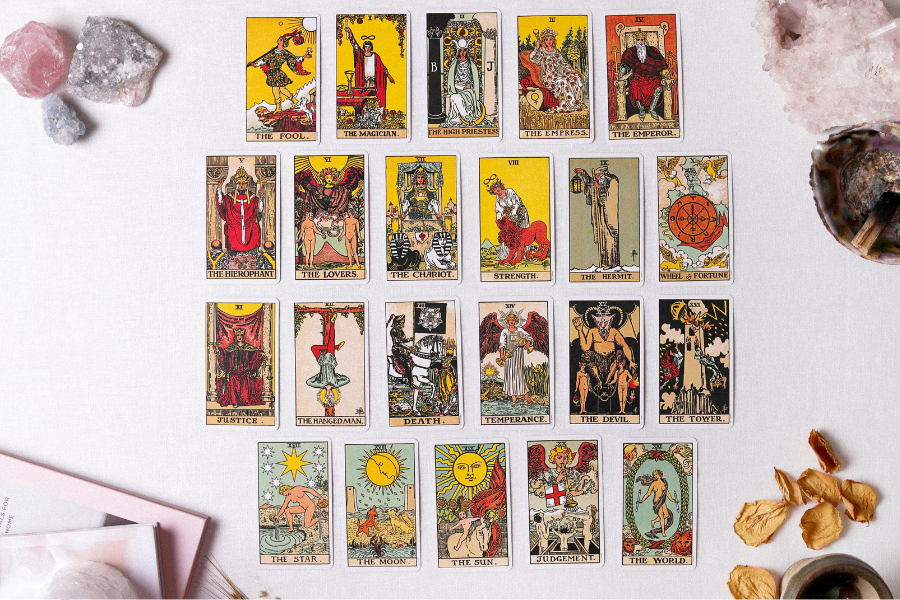
The Tower: The Cosmic Renovator The Tower is not a disaster. It’s the demolition crew that shows up when your house is built on a bad foundation. It’s the shocking text message, the surprise job loss, the sudden “this isn’t working anymore.” It’s not the end of your story; it’s the destruction of the thing that was about to collapse anyway. It says: “This needs to go.”
The Devil: The Master of Illusion The Devil is not a demon. The Devil is a prison where the door is unlocked from the inside. He represents addiction, obsession, unhealthy bonds, and the belief that you have no choice. The Devil isn’t what traps you; it’s the part of you that’s decided the trap is a comfortable cage.
Death: The Ultimate Rebrand The hardest part of Death is its name. This isn’t a “something died” card. It’s a “this is over” card. It is the final, non-negotiable ending that makes the next beginning possible. No death, no rebirth. It is the universe’s definitive, “No, for real this time, I mean it.”
The “Bad” Reading is the Real Reading
The most important reading you will ever do is the one that makes you say “Huh?” That confusion is the space where real growth happens. The easy readings are a comfort. The hard ones are a curriculum.
Your homework this week: Go back to a reading that confused you. Don’t try to “figure it out.” Just look at the cards. Ask them: “What is the one thing you need me to feel right now?” Not think. Feel. The answer is often a feeling, long before it becomes a thought.
The tarot doesn’t speak in answers. It speaks in a language of symbols that we must feel our way through. And sometimes, the “bad” reading is the only one that tells you the truth you’re afraid to say out loud.
Next time, we’ll talk about what to do after the reading—how to take the message and actually use it to change your life. This is where the real magic begins.