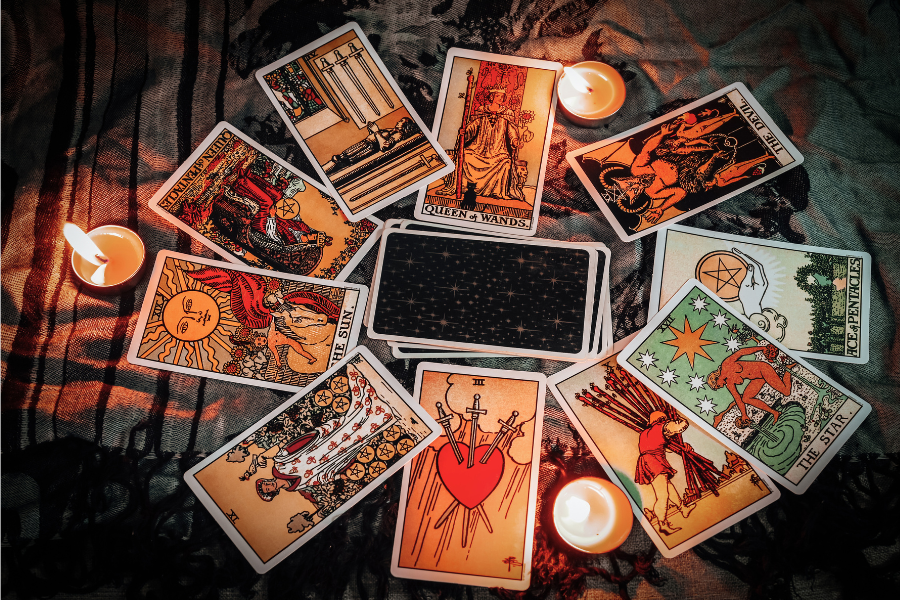
Okay, let’s be real. When you first see the Celtic Cross spread with all its lines and positions, it looks like a puzzle. Ten cards. Different positions. It’s the tarot equivalent of walking into a final exam you never studied for.
But here’s the secret the “tarot experts” won’t tell you: this spread is just a really good, really specific story. And you, my friend, are about to become the storyteller.
Think of the Celtic Cross not as a puzzle to solve, but as a map. A map for the question you’re holding in your heart. Let’s learn to read it, one step—no, one story—at a time.
Forget Memorizing, Let’s Map It Out
First, let’s ditch the intimidation. We’ll build the spread like we’re setting up a story, placing the “map” card by card. Imagine we’re laying out a storyboard for a movie.
Here’s the ‘Storyboard’ (The Celtic Cross Layout):
- The Heart (Card 1, Center): This is you, or the person you’re reading for. It’s the main character in the center of it all.
- The Challenge (Card 2, crossing Card 1): This is the main character’s current problem, obstacle, or the thing they’re wrestling with. It’s the central conflict.
- The Foundation (Below): This is the deep-down reason why this is all happening. The old stuff. The family pattern, the old wound, the hidden belief.
- The Recent Past (Left): What just happened that led you right here, right now?
- The Best-Case (Top): The best possible outcome if everything goes perfectly. The goal or hope.
- What’s Coming Next (Right): The immediate, likely outcome if nothing changes.
- Your Role (Bottom of Staff): This is how you’re showing up in the situation.
- Your World (Second in Staff): The environment and people around you. The “supporting cast.”
- Hopes and Fears (Third in Staff): The deep-down wish (or fear) that fuels this whole thing.
- The Final Word (Top of Staff): The most likely outcome, given all of the above.
The 4-Card Story Method: Your Cheat Code
You don’t start reading 10 cards at once. You read them in chapters. Treat the first 6 cards (the “Cross” in the Celtic Cross) as the first part of the story.
- The Situation (Card 1) and Its Challenge (Card 2): The story starts here. Read Card 1 (the main character’s state) and Card 2 (the main problem) together.
- The Why (Card 3 – The Foundation): This tells you the source of the conflict. Is it an old story playing out? A deep fear?
- The Backstory (Card 4 – The Past): How did you get here? This is the recent event or influence that set the stage.
- The Goal (Card 5) vs. The Path (Card 6): This is the “what if.” Card 5 is the ideal, hopeful outcome. Card 6 is the likely path you’re on now. The gap between them is the story.
Your First Time? Do a 3-Card Warm Up.
Before the full Celtic Cross, do a Practice Spread:
- The Situation Now (Present)
- The Action/Advice (What to do)
- The Potential Outcome
Shuffle and pull three cards. Practice telling a mini-story. “Right now, there’s [Card 1]. To move forward, the card suggests [Card 2]. The potential I’m heading toward is [Card 3].”
The Secret: You’re the Author, Not the Translator
Your intuition is not a dictionary. When you draw the Nine of Swords, don’t just think “anxiety.” Look at the card. See the figure in bed, head in hands. You don’t need a book to tell you this is about restless nights and worry. The image is the meaning. Let the picture stir a feeling in you, then put it into your own words for the person in front of you.
Your Celtic Cross “Cheat Sheet” for a 3-Minute Reading
- The Core Conflict: Look at Cards 1 & 2. How does the challenge (Card 2) block or pressure the main person/situation (Card 1)? This is your central conflict.
- The Root & The Path: Look at Card 3 (Foundation). How does this deep-seated issue feed the current conflict? Does it explain the “why” of the problem?
- The Possible Ending: The final card on the staff is not a prison sentence. It’s the “if-then” ending: If things continue as they are, and all these influences in positions 7, 8, and 9 are in play, the most likely resolution is… It’s the “To be continued…” in a comic book.
One Last, Crucial Thing
The Celtic Cross isn’t a crystal ball showing a fixed future. It’s a spotlight. It shines a light on the story you’re already living, showing you the characters (the cards), their motivations (the positions), and the plot so far. You are the director of this movie. The Celtic Cross is your storyboard. And now, you know how to read the map.
The magic isn’t in memorizing 78 card-meanings. It’s in letting the pictures on ten little cards tell you a story about a person, a problem, and a path forward. You can do this.